Physical Address
304 North Cardinal St.
Dorchester Center, MA 02124
Physical Address
304 North Cardinal St.
Dorchester Center, MA 02124
The car is chosen. The price is agreed. The customer is ready to sign.
And then the paperwork starts.
Most people don’t realize how much time gets lost in that final stretch — not during negotiation, not during the test drive, but in the documentation phase. Purchase agreements, loan paperwork, insurance declarations, RTO forms. A stack of documents that, in many dealerships, still moves the same way it did twenty years ago.
That’s where deals quietly fall apart.
Ask any dealership manager where their biggest delays happen. They’ll mention inventory issues, financing approval timelines, or customer hesitation. Rarely does anyone point to document handling.
But the numbers tell a different story.
A customer who leaves the showroom without signing — even one who’s genuinely interested — is a risk. Life gets in the way. A competitor follows up faster. Another dealership offers digital convenience. And suddenly a deal that felt closed is back to being uncertain.
The signature itself takes less than a minute.
Getting to that signature? That can take days.
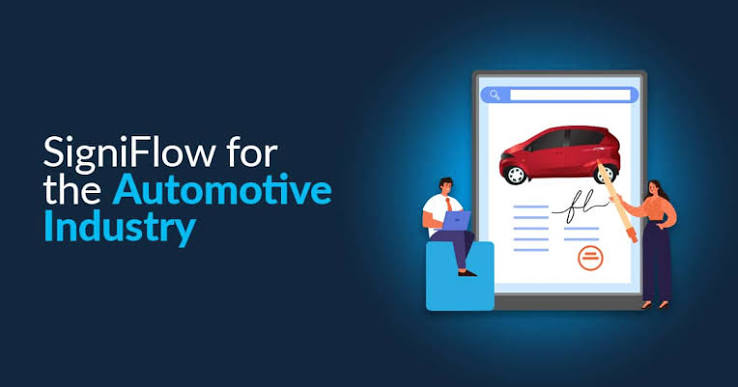
This is precisely why electronic signatures for automotive industry are no longer optional infrastructure — they’re becoming a core part of how competitive dealerships operate.
Physical paperwork in vehicle sales isn’t just slow. It creates a chain of small inefficiencies that compound quickly.
Consider a standard financing workflow. The sales executive sends documents for review. The customer needs to print, sign, scan, and return. Finance teams chase approvals. Compliance checks happen manually. A single missing field or mismatched date requires starting that cycle again.
Different departments. Different timelines. Different inboxes.
That alone can delay a deal by two or three business days — without anyone actually doing anything wrong.
In high-volume dealerships, multiply that across fifty transactions a month. The operational drag becomes significant, and almost entirely invisible on a standard sales report.
A digitally enabled signing workflow doesn’t just move faster. It removes entire steps from the process.
The customer receives a secure document link from an electronic signature platform like EazeeSign, they review it on their phone, and sign within minutes. The dealership gets an instant confirmation. No printing. No scanning. No follow-up emails asking whether the form arrived.
Here’s what that looks like in practice.
A customer finalizes their vehicle choice on a Saturday afternoon. Instead of scheduling a return visit for paperwork, the finance manager sends a digital agreement immediately. The customer signs from home that evening. By Monday morning, the deal is documented, verified, and ready for processing.
Two days saved. No courier. No chasing.
For a dealership moving forty or fifty units a month, that’s not a marginal improvement — it’s a measurable shift in sales velocity.
Vehicle financing paperwork has layers most customers never see.
Loan agreements, hypothecation letters, insurance declarations, Form 35 — each carries its own requirements. In many cases, multiple parties need to sign. A buyer, a co-applicant, a finance company representative. Sometimes a guarantor.
Managing that manually across multiple signatories is where errors accumulate. A missing date here. A mismatched field there. Mistakes that don’t surface until the submission stage, at which point the entire sequence needs to restart.
Electronic signature platforms with built-in field validation catch those gaps before the document moves forward. Required fields can’t be skipped. Signing sequences are enforced by the workflow itself — not by someone remembering to follow up.
That’s a structural fix, not just a speed fix.
Do electronic signatures hold up legally in automotive transactions?
In India, the Information Technology Act 2000 establishes the legal standing of electronic signatures for commercial documents. Aadhaar-based eSign adds a further layer of authentication — particularly useful for high-value vehicle financing agreements where identity verification matters.
Platforms built around these standards generate a complete, tamper-evident audit trail for every document. Who signed. When. From which device. In what sequence.
For dealerships that have ever faced a financing dispute or RTO documentation query, that audit trail isn’t just a technical feature. It’s protection.
Beyond customer experience, the internal shift is significant.
Sales teams spend less time on administrative follow-up. Finance executives stop managing document versions across scattered email threads. Compliance teams pull records on demand instead of searching physical files. And dealership principals get real-time visibility into where every pending agreement stands — without asking anyone.
That visibility piece tends to surprise people. It sounds like a minor convenience. In practice, it changes how deals get prioritized and how pipeline reviews happen internally.
Nobody likes guessing whether a document has been received.
Manual document handling carries costs that don’t appear as line items.
Staff hours spent on follow-up. Deals delayed past the customer’s decision window. Errors requiring correction workflows. Physical storage for compliance records. Courier fees. Reprinting costs.
None of these feel large individually. Together, they represent a meaningful drain on both time and budget — particularly for multi-location dealership groups managing volume across branches.
A few common pressure points worth examining:
Switching to a digital signing workflow reduces the surface area for things to go wrong across all of these.
The efficiency gains are expected. The compliance confidence usually comes as a surprise.
Most dealership managers who move to electronic signatures report that their team’s follow-up burden drops significantly within the first month. Not because the deals get easier — but because the documents stop being a variable in the process.
The deal is closed. The paperwork confirms it. The next transaction begins.
That shift — from documentation as a bottleneck to documentation as a formality — is what a well-implemented electronic signature workflow actually delivers in automotive sales. And for dealerships still running on manual approvals and printed forms, the gap between them and faster-moving competitors is only getting wider.