Physical Address
304 North Cardinal St.
Dorchester Center, MA 02124
Physical Address
304 North Cardinal St.
Dorchester Center, MA 02124
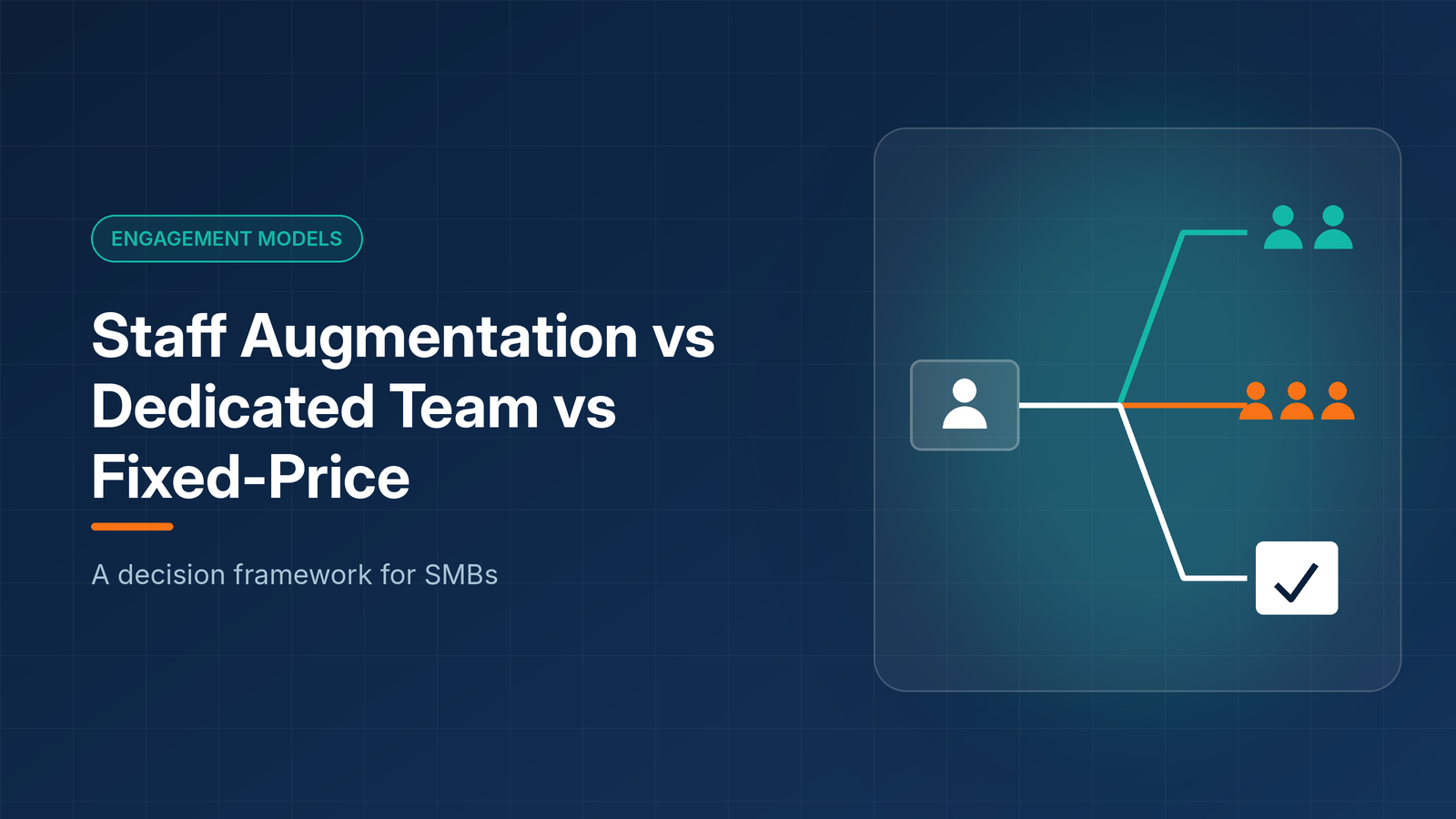
When you compare staff augmentation vs dedicated team vs fixed-price, the short answer is this. Staff augmentation adds people to a team you already lead. A dedicated team takes ownership of ongoing product work. Fixed-price buys a clearly defined result for an agreed cost. The right choice depends on how much control you want, how stable your scope is and who will manage the work.
This framework helps startups with one to three in-house developers make that call without guesswork.
Most outsourcing contracts fall into one of three software engagement models. Each one shifts responsibility in a different direction.
You hire external developers who join your existing team. They follow your processes, attend your standups and take tasks from your backlog. You keep full control of priorities and technical decisions.
You manage: everything. The vendor manages: hiring, payroll and replacements.
A vendor provides a stable team, often with its own project manager or tech lead, that works only on your product. You set the direction and priorities. The team handles day-to-day delivery.
If you’re considering a dedicated development team, check whether a tech lead is included or whether that role still sits with you.
You manage: product direction. The vendor manages: delivery and team health.
You agree on a defined scope, timeline and price before work starts. The vendor owns delivery against that scope. Changes go through a formal change request process.
You manage: requirements and acceptance. The vendor manages: almost everything else.
The table below compares the three models on the five factors that matter most to small engineering teams.
|
Factor |
Staff augmentation |
Dedicated team |
Fixed-price |
|
Control |
High: you direct daily work |
Medium: you set priorities, team runs delivery |
Low: vendor controls how work is done |
|
Cost predictability |
Medium: monthly or hourly, varies with headcount |
High: stable monthly fee |
High at signing, lower if scope changes |
|
Speed to start |
Fast: days to a few weeks |
Medium: a few weeks to form the team |
Slower: scoping and estimates come first |
|
Scope change |
Easy: change the backlog anytime |
Easy: reprioritize sprint by sprint |
Hard: every change needs a new estimate |
|
Team size fit |
1–5 people added to your team |
3–10 people as a unit |
Any size, hidden from you |
Notice that no model wins on every factor. You’re trading control for management effort, and flexibility for predictability.
Staff augmentation and dedicated teams are both forms of time and materials (T&M) billing. You pay for the people and the time they spend. Fixed-price is the opposite: you pay for an outcome.
The fixed price vs time and materials question usually comes down to one thing: how sure are you about the scope?
Fixed-price works well when:
It works poorly when:
Vendors price risk into fixed bids. If the scope is uncertain, expect a buffer in the price, frequent change requests, or both. In early-stage products, T&M models are often cheaper in practice, even when the hourly rate looks higher.
Use this table to match your situation to a model. Find the row closest to where you are today.
|
Scenario |
Model that fits |
Why |
Watch-outs |
|
You have a CTO and 2 developers, but a growing backlog |
Staff augmentation |
You keep control and add capacity quickly |
Your CTO’s time becomes the bottleneck |
|
You need a specific skill (e.g., React Native, DevOps) for 2–3 months |
Staff augmentation |
Short-term access to a skill you don’t need full-time |
Plan knowledge transfer before they leave |
|
You’re building a new product line with no spare engineering lead |
Dedicated team |
The team brings its own delivery management |
Define product ownership clearly on your side |
|
You’re maintaining and extending a product for 12+ months |
Dedicated team |
Stable people keep product knowledge |
Review output and velocity monthly |
|
You need a well-defined MVP or a one-off integration |
Fixed-price |
Clear cost and deadline for clear scope |
Weak specs lead to change requests |
|
You’re validating an idea and scope changes weekly |
Staff augmentation or small dedicated team |
You can change direction without renegotiating |
Set a monthly budget cap |
|
You face a short delivery spike before a launch |
Staff augmentation |
Add people for a few sprints, then scale down |
Onboarding time eats into short engagements |
For delivery spikes and short-term needs, look for on-demand developers for short sprints who can start quickly and roll off cleanly. Ask how much notice the vendor needs to add or remove people.
Staff augmentation is often the first model small teams try, because it feels like hiring without the overhead. Knowing when to use staff augmentation, and when to avoid it, saves months of frustration.
Use staff augmentation when:
Avoid it when:
A simple test: if adding two developers tomorrow would create more meetings for your CTO than features for your users, staff augmentation isn’t the fix yet.
When it does fit, good IT staff augmentation should feel like hiring. Ask to interview each developer, agree on working hours that overlap with yours, and treat them as part of the team from day one.
Answer these questions in order. Stop at the first one that gives you a clear answer.
Many companies end up mixing models over time. A common path is a fixed-price MVP, then a dedicated team to grow the product, with staff augmentation for short spikes.
There’s no universally right engagement model, only the one that fits your scope, your management capacity and your timeline. Run through the 5-question flow before you talk to vendors. Then pick the model first and the vendor second, so the conversation stays about your needs rather than their sales process.
What is the main difference between staff augmentation and a dedicated team?
The main difference is who manages delivery. With staff augmentation, you manage the developers directly; with a dedicated team, the vendor manages day-to-day delivery while you set priorities.
Is fixed-price cheaper than time and materials?
Not always. Fixed-price gives a clear number upfront, but vendors add a risk buffer, and scope changes add cost, so T&M is often cheaper for evolving products.
When should a startup use staff augmentation?
Use it when you have an in-house technical lead and need extra capacity or a specific skill quickly. It works poorly if no one has time to manage the added developers.
Can I switch engagement models later?
Yes. Many companies start with fixed-price or staff augmentation and move to a dedicated team once the product and roadmap are stable.
How big should a dedicated team be?
Most small-business dedicated teams have three to six people. That usually means a few developers, plus a tech lead or project manager and sometimes a QA engineer.
Devansh Desai is CTO at Rushkar Technology, a software development company working with clients in the USA, UK and Australia since 2016. He writes about software engagement models, team structure and scaling engineering for growing companies.